


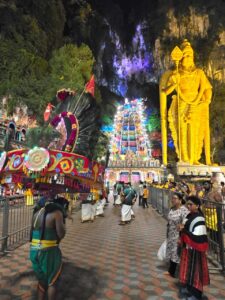
 On Thaipusam today, Batu Caves reveals itself as far more than stone steps and steep climbs. Each of its 272 steps carries prayers, vows, and silent acts of endurance, turning a physical ascent into a sacred inner journey.
Batu Caves, leading to the Sri Subramaniar Swamy Temple in Kuala Lumpur, is not merely a place of worship but also a geological marvel and a global symbol of faith, energy, and alignment.
From a Vasthu Sastra perspective, Batu Caves enjoys a powerful natural setting.
Carved into ancient limestone estimated to be over 400 million years old, the caves rise from the earth like a natural sacred mountain.
In Vasthu, mountains and elevated landforms are considered reservoirs of stabilising cosmic energy, grounding human aspiration while drawing the mind upward.
Perhaps this is why Batu Caves has, for generations, drawn seekers not only to worship but also to realign themselves with a higher order.
For me, Batu Caves embodies a spiritual journey that has unfolded across the many stages of my life.
I have visited this iconic site countless times since childhood, and each climb has carried new meaning for me as a boy, a reflective adult, and one devotee among the sea of pilgrims who gather here during Thaipusam.
Vasthu teaches us that spaces interact differently with us as we change.
What once felt physically demanding later becomes emotionally revealing, and eventually spiritually instructive.
Batu Caves is among Malaysia’s most revered Hindu shrines and is recognised worldwide as a centre of devotion.
I was there on Friday, two days before the event, to avoid the crowds and heat, standing among thousands of devotees and visitors who turned the limestone cliffs and temple grounds into a living spectacle of faith, endurance, and surrender.
The sheer scale of human movement, flowing steadily toward the cave, mirrors what Vasthu calls prana flow, energy in motion, purposeful and directed.
At the foot of the caves stands the golden statue of Lord Murugan, commanding both awe and reverence.
Rising 42.7 metres, the tallest Lord Murugan statue in the world gleams under the sun, radiating majesty and serenity.
The Lord Murugan statue now stands alongside Christ the Redeemer in Rio de Janeiro, Brazil and the Kaaba, Masjid al-Haram (Mecca, Saudi Arabia), as the world’s top three most-photographed spiritual icons.
From a spatial perspective, its placement is significant. In Vasthu, a guardian deity positioned at the threshold anchors protective energy and establishes a sacred boundary.
More than a monument, the statue feels like a sentinel, watching over Kuala Lumpur and the steady stream of devotees climbing the steps with offerings, prayers, and penance.
In its stillness, I sensed strength, protection, and an unspoken invitation to rise above personal struggles with the same courage reflected in the pilgrims’ ascent.
Thaipusam has always held a special place in my heart.
From an early age, I was drawn to the sights, sounds, and colours that envelop Batu Caves during this sacred time.
As I joined thousands of pilgrimages, each carrying a story, a vow, or a prayer, some offering gratitude for blessings received, others seeking healing, fulfilment, or spiritual strength.
Vasthu reminds us that intention activates space; it is not the structure alone that sanctifies a place, but the collective consciousness.
Acts of devotion take many forms. Men, women, and even children shave their heads in humility and surrender, offering their hair to the deity.
Others carry milk pots or bear elaborate kavadis, ornate wooden or metal structures adorned with peacock feathers, images of deities and flowers, often balanced by piercing.
While daunting to the casual observer, these rituals are understood by devotees as conscious expressions of faith and penance.
From an energetic perspective, these acts symbolise shedding ego and accumulated burdens, allowing the body and mind to realign.
The atmosphere was charged with chants of “Vel! Vel!” as the faithful climbed. Drums beat relentlessly, incense hangs in the air, and determination is etched onto every face.
According to Vasthu, sound is a potent activator of space. The rhythmic chanting and percussion seem to awaken the very stone beneath our feet, creating an invisible field that carries devotees forward even when the body tires.
The rainbow-painted staircase leading to the main cave temple is symbolic in itself.
Many devotees see the progression of colours as reflecting the soul’s ascent from the earthly to the divine.
Each of the 272 steps is said to represent stages in life’s journey.
The climb becomes both a physical challenge and a spiritual metaphor.
In Vasthu terms, ascending movement signifies evolution, a conscious effort to move from
heaviness, confusion, and stagnation to lightness, calm, and clear awareness.
For some, the ascent is steady and light. For others, each step is an uphill battle, mirroring burdens carried within: regret, sorrow, guilt, or unfulfilled promises.
I saw devotees pause midway, tears flowing freely, as though the climb had unlocked emotions long suppressed.
Others winced in pain yet pressed on, believing that suffering itself is part of the offering.
The body, Vasthu tells us, stores unresolved energy; movement, prayer, and intention allow it to be released.
What strikes me most is that this pilgrimage is never about speed.
It is not about who reaches the top first, but how one arrives there.
Each person’s pace reflects their inner state and the invisible weight they carry.
Some arrive breathless and exhausted; others seem to glow with calm.
Yet when the summit is finally reached, a shared sense of relief washes over the crowd.
Faces once strained soften into smiles, and many believe they have shed their sins upon those steps, emerging lighter in spirit.
Each time I make this climb, I feel a renewed connection, not only with Lord Murugan, but with the countless devotees who have walked this path over centuries.
As a boy, the steps alternated between daunting and playful.
With age, they became mirrors of life’s trials, mistakes, and lessons.
There were times when my own ascent felt heavy, echoing personal struggles.
Yet standing before the sanctum at the summit, I experienced the same release so many devotees describe, a clearer mind, a calmer heart, and the quiet assurance that burdens, too, can be transcended.
The Batu Caves pilgrimage transcends religion.
What makes Batu Caves extraordinary is that it is not merely about ritual, but transformation. The ancient limestone stands as a silent witness to humanity’s enduring search for meaning. The steps remind us that every journey, however demanding, has a summit.
And the temple at the top reminds us that when space, intention, and faith align, as Vasthu teaches, we find the strength to rise above the burdens of life.
Award-winning writer Dr T. Selva is the author of the bestsellers Vasthu Sastra Guide and Secrets of Happy Living. To get a copy, WhatsApp 019-2728464. He can be reached at drtselvas@gmail.com. Facebook: Vasthu Sastra