



When there is no goodbye
By Dr. T. Selva
There are moments in life when grief arrives with death.
There is a body to mourn, prayers to perform, tears to shed and, painful as it may be, a reality
that the heart must eventually learn to accept.
But what happens when there is no body, no final word and no certainty whether the person
you love is dead or alive?
That is the unbearable position in which thousands of families now find themselves following
the catastrophic glacial and mountain collapse and floods along the Nepal-China border on
Aug 26.
As of Sept 11, more than 5,500 people were still reported missing across Nepal and Tibet,
while rescue and recovery operations continued.
Among them are 55 Malaysians who remain unaccounted for in Nepal, with DNA samples
already obtained from their next of kin to assist identification efforts.
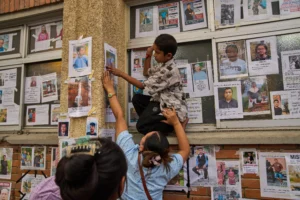
Behind each number is a family waiting for the telephone to ring. A mother may still be
staring at her child’s photograph.
A husband may be rereading his wife’s final message. Children may be asking when their
father is coming home.
How does one mourn somebody who is missing?
The answer is that there may be no conventional way.
Psychologists describe this as ambiguous loss, when somebody is physically absent but
remains psychologically and emotionally present.
Unlike death, there is no certainty to allow grief to follow its normal course.
Another question lingers: What if he survived? What if she is injured somewhere? What if
rescuers reach them tomorrow?
The uncertainty can freeze grief. Families can feel unable to mourn, yet unable to continue
living normally.
I am in Vietnam on a spiritual retreat now, and I was connected to the late Vietnamese Zen
master Thich Nhat Hanh’s teaching, which offered a beautiful understanding of separation.
He taught that the people we love do not simply vanish from our existence.
They continue through the lives they have touched, through memories, actions, words and
love.
Although his teachings frequently addressed death, I believe they offer something insightful
for families of the missing.
You do not have to decide today whether your loved one has departed this world.
You can continue loving someone in their absence.
You can speak their name, keep their photograph close, remember their laughter, offer
prayers, and continue searching.
And you can hope.
Research on ambiguous loss suggests that the aim should not necessarily be “closure”,
because sometimes closure is impossible.
Instead, people gradually learn to live meaningfully while carrying unanswered questions.
Malaysia understands this pain only too well.
On March 8, 2014, Malaysia Airlines flight MH370 vanished with 239 people aboard.
More than 12 years later, its wreckage has still not been located.
The Malaysian Government extended its agreement with Ocean Infinity this year to continue
searching until June 30, 2027, another reminder that for the families, the story remains
unfinished.
For them, as for the families now waiting for news from Nepal, the most difficult words may
be: “We do not know.”
So, should relatives continue hoping for a miracle?
Absolutely.
Hope is not wrong.
In fact, this disaster reminds us to be careful not to extinguish hope prematurely. Workers
have been rescued alive many days after the catastrophe.
Two people were pulled alive from a hydropower tunnel nine days after the disaster.
Until there is certainty, missing does not mean dead.
But spirituality also teaches us that hope need not mean refusing every other possibility.
We can hold two prayers in our hearts simultaneously: May my loved one return safely, and,
Whatever has happened, may God give us the strength to face the truth.
This brings us to a particularly sensitive question: Should funeral rites be performed for
someone whose body has not been found?
No single answer fits every family or every faith.
In Hindu tradition, there are provisions in some communities for symbolic funeral rites when
a person is presumed to have died, but the body cannot be recovered.
Indeed, some families in Nepal affected by this disaster have performed symbolic cremations
using effigies in place of the missing body.
But I would hesitate to tell a family to rush into final rites while rescue operations remain
active and the person’s fate remains genuinely unknown.
The final rites are, after all, the final auspicious ceremony.
Customs also differ greatly among Hindu communities, so families facing such circumstances
should seek guidance from spiritual experts and consider information available from
authorities before taking such a big step.
However, nothing prevents us from praying.
A lamp can be lit.
Families can visit temples, churches, mosques, or other sacred spaces, depending on their
faith. And the prayer need not say goodbye.
It can simply say:
Wherever you are, may you be protected. If you are alive, may help reach you. If you have left
this world, may your soul be at peace. And may we be given the strength to accept the truth
when it comes.
Perhaps that is the most appropriate spiritual prayer when no human being can provide an
answer.
Moving forward also does not mean abandoning the missing person.
You are allowed to laugh again. You are allowed to eat, sleep, work, celebrate another child’s
birthday, or enjoy a beautiful sunrise.
Continuing to live is not a betrayal of the missing person.
Hope also does not require putting one’s entire life on hold.
We sometimes misunderstand closure as shutting a door.
But love does not work that way. Even when death is certain, we do not erase people from
our hearts. We learn to carry them differently.
For families of the missing, the door may remain slightly open for years.
Spiritual strength may therefore come not from finding an answer, but from surrendering the
demand that an answer must come today.
Some situations cannot change what has already happened.
But prayer can change the person who has to endure it.
It gives the frightened heart somewhere to place its fear.
It reminds us that beyond rescue teams, satellite images, DNA testing and human limitations
lies a mystery greater than ourselves.
For the families of the thousands still missing in the Himalayas, and particularly the families
of our 55 Malaysians, may hope remain alive for as long as hope is possible.
And when the truth finally comes, whatever that truth may be, may they have the strength to
receive it.
Until then, perhaps we should not pray for closure.
We should pray for clarity, courage and peace.
Award-winning writer Dr. T. Selva is the author of the bestselling books Vasthu Sastra
Guide and Secrets of Happy Living. To obtain a copy, WhatsApp 019-2728464. He can
be reached at drtselvas@gmail.com. Website: www.vasthuguide.com.