



By Dr. T. Selva
As a parent, few sounds are as piercing and emotionally draining as the persistent,
unexplained cries of a newborn.
You have checked everything: the diaper is dry, the baby has been fed, the room is
comfortable and there is no apparent sign of illness.
Yet the crying continues, sometimes throughout the day and night, leaving the parents
exhausted, anxious and helpless.
When a baby cries persistently, medical advice must always come first.
A pediatrician can assess possible causes such as colic, reflux, trapped wind, feeding
difficulties, infection or other health conditions.
Parents should seek prompt medical attention if the crying is accompanied by fever, breathing
difficulty, repeated vomiting, poor feeding, fewer wet diapers, unusual drowsiness, a weak or
high-pitched cry, or if the baby appears pale, floppy or unresponsive.
Once possible medical causes have been properly investigated, parents may also wish to
consider the traditional perspectives offered by Vedic astrology and Vasthu Sastra.
These ancient Indian sciences view a baby’s cry not merely as a demand but as an important
form of communication.
It can reflect the infant’s physical needs, emotional sensitivity and response to the
surrounding environment.
According to Vedic astrology, every newborn enters the world with a unique birth chart, a
cosmic representation of the planetary positions at the exact time and place of birth.
Within this traditional system, the chart provides insights into the child’s personality,
temperament and emotional constitution.
The Moon is the principal celestial body associated with the mind and emotions.
If the Moon is weak, unfavourably positioned or influenced by challenging planets such as
Saturn, Rahu (dragon head) or Ketu (dragon tail), astrologers believe the child may possess a
highly sensitive, anxious or restless nature.
This sensitivity may be expressed through disturbed sleep, difficulty settling down and
frequent crying.
It does not mean that anything is inherently wrong with the child.
Instead, it suggests that the baby may require a calmer environment, a more consistent routine
and additional emotional reassurance.
Other planetary influences may also be considered.
A strong or afflicted Mars is traditionally associated with heat, impatience and irritability,
while a challenging Saturn influence may contribute to uneasiness or difficulty adjusting to
unfamiliar surroundings.
These planetary conditions should never be interpreted as indications of a “bad” or difficult
baby.
They are simply part of the child’s individual cosmic pattern and may help parents understand
why one baby responds differently from another under similar circumstances.
The astrological connection also extends to the mother.
During the first few months of life, a baby remains deeply attuned to the mother’s physical
and emotional state.
If she is exhausted, anxious or overwhelmed, the baby may sense her tension and respond by
becoming unsettled.
Therefore, the well-being of the mother is equally important.
Adequate rest, practical help from family members and a peaceful home environment can
benefit both mother and child.
One gentle traditional remedy involves sound vibration.
Softly chanting a calming mantra such as “Aum Shanti” or an appropriate mantra dedicated
to the Moon can help create a serene atmosphere.
The baby may not understand the words, but the gentle rhythm of the chanting, combined
with the reassuring presence of a parent, may provide comfort.
Soft devotional music, lullabies or quiet instrumental music may have a similarly soothing
effect.
Having considered the cosmic influences, we should also examine the baby’s immediate
physical environment.
According to Vasthu Sastra, a home is not merely a physical structure.
It is regarded as a living field of subtle energy.
A newborn, whose senses are still developing, may be especially receptive to the atmosphere,
sounds, lighting and energetic flow within the home.
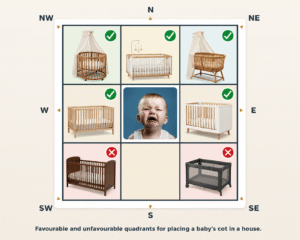
In Vasthu, the location of the baby’s bedroom is important.
The north-west is often recommended for a young child because it is associated with the air
element and movement.
When properly balanced, it is believed to support healthy development and a peaceful mental
state.
A bedroom in the south-east—the fire-element quadrant—may sometimes feel overly active
or stimulating for an infant.
The south-west, although favourable for the head of the household, carries a heavier and
more grounded energy that may not always be suitable for a newborn.
The other locations that are considered acceptable are north, east, north-east and west.
However, each property is different, and the entire floor plan should be assessed before
reaching a conclusion.
The direction of the main entrance, room arrangement, missing corners and surrounding
environment can all influence the overall Vasthu interpretation.
The position of the cradle or crib is equally important.
It may be aligned along the north-south axis, with the baby’s head pointing towards the south
and legs towards the north.
This sleeping orientation is traditionally believed to encourage stability and more restful
sleep.
Regardless of direction, the baby should always be placed on their back on a firm, flat and
safe sleeping surface.
The crib should be kept free of pillows, loose blankets, toys, cot bumpers and other soft
objects that could obstruct the baby’s breathing.
Avoid positioning the crib directly beneath an exposed structural beam, as beams are believed
to create a sense of downward pressure.
It is also preferable not to place the crib directly in line with the bedroom door, where
movement, light and noise may repeatedly disturb the child.
Sharp furniture corners pointing towards the crib, mirrors reflecting the sleeping baby and
excessive clutter around the sleeping area should also be avoided.
Keeping the room clean, orderly and well ventilated encourages a calmer and more
comforting atmosphere.
Colours can also influence the mood of the room.
Instead of harsh, aggressive or excessively bright shades, choose soft pastel tones such as
beige, cream, gentle pink, light blue or pale green.
These colours create a peaceful visual environment and are less likely to overstimulate the
baby.
Avoid black, dark blue, yellow and grey.
Many Vasthu concerns can be addressed without making major structural alterations.
Repositioning the crib, clearing unnecessary clutter, improving ventilation and using a soft,
warm nightlight may make the room feel more settled.
A small bowl of sea salt is also traditionally used to absorb undesirable energy.
If used, it should be placed securely and completely out of the reach of children and pets, and
the salt should be replaced regularly.
Parents should remember that every baby cries. Crying is the newborn’s natural way of
communicating hunger, discomfort, tiredness, loneliness or the need to be held.
There may not always be a single explanation.
Medical care, parental patience, emotional reassurance and a harmonious home environment
should work together.
Astrology and Vasthu can offer additional traditional insights, but they should be approached
with balance, compassion and common sense.
When parents remain calm and create a secure, peaceful atmosphere, the baby is more likely
to feel safe.
Sometimes the most powerful remedy is simply the loving voice, gentle touch and reassuring
presence of a parent.
Award-winning writer Dr. T. Selva is the author of the bestsellers Vasthu Sastra Guide
and Secrets of Happy Living. To obtain a copy, WhatsApp 019-2728464. He can be
reached at drtselvas@gmail.com. Website: www.vasthuguide.com