



By Dr. T. Selva
One of the most frequently asked questions in Hindu homes today is: “There are so many
deities in Hinduism. Which ones should we keep on our home altar?”
Over the years, many families accumulate numerous framed pictures, statues, calendars,
laminated images, prayer cards, and idols received from temples, relatives, and friends.
Eventually, the altar becomes overcrowded, visually confusing and difficult to maintain, both
spiritually and physically.
Some spiritual seekers may then worry that they are doing something wrong by not
worshipping every deity equally.
Hinduism recognises countless forms and manifestations of the Divine. However, Hindu
philosophy teaches that these deities represent different aspects of the one Supreme Cosmic
Energy.
The many divine forms allow devotees to connect with God according to their temperament,
family tradition, spiritual path and personal devotion.
Therefore, a home altar does not need to contain every deity. What matters most is sincerity,
devotion, cleanliness and a genuine spiritual connection.
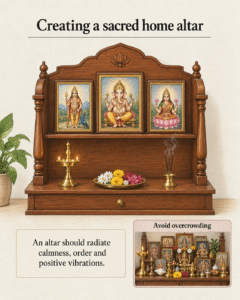
A home altar should never become a storage space for every religious image accumulated
over the years.
It is the sacred spiritual centre of the home, a place for prayer, meditation, gratitude and inner
peace.
The altar should radiate calmness, order and positive vibrations.
When too many images and statues are crowded together, spiritual focus may become diluted,
and the space may feel cluttered rather than uplifting.
In traditional spiritual practice, simplicity is often preferred over excess.
Which deities should be kept?
No rigid rule governs which deities to place on a home altar.
Traditionally, families select them according to their lineage, kula deivam or family deity,
personal devotion and spiritual guidance.
Some commonly worshipped deities include:
Lord Ganesha—the remover of obstacles and guardian of new beginnings.
Lord Shiva—the embodiment of transformation, inner stillness and higher
consciousness.
Goddess Lakshmi—associated with prosperity, harmony and abundance.
Goddess Saraswati—representing wisdom, learning and creativity.
For many households, three to five principal deities are spiritually sufficient and easier to
worship and maintain with devotion and discipline.
Although there is no limit to the number of deities. for a home altar, many spiritual teachers
advise moderation.
The important question is not, “How many deities do I have?” Rather, it is, “Can I worship
and maintain them sincerely and respectfully?”
When an altar becomes overcrowded with dusty, damaged, or neglected images, the serenity
and sanctity of the sacred space may be diminished.
A small altar maintained with reverence can be spiritually more meaningful than a large but
cluttered one.
In Vasthu Sastra and traditional temple principles, orderliness, cleanliness and the
harmonious flow of energy are important. The altar should inspire serenity and devotion, not
visual overload.
Today, people sometimes buy deity statues merely as decorative objects or interior
accessories. Never treat sacred images casually.
Once an image or statue has been placed on the altar and regularly worshipped, it acquires
special spiritual significance through prayer and devotion.
Therefore, handle it with care and reverence.
Devotees should observe the following guidelines:
Avoid keeping broken or badly damaged statues on the altar.
Torn, faded, or damaged pictures should be respectfully removed.
Do not stack deity pictures on the floor or leave them neglected in drawers.
Avoid placing sacred images near shoes, bathrooms or other inappropriate areas.
Keep the altar clean, orderly and free from unnecessary objects.
How should old or broken sacred images be retired?
This is a sensitive and important issue because many devotees feel guilty or fearful about
removing blessed images.
However, Hindu traditions offer respectful ways to retire damaged or unused devotional
items.
Customs may differ between families, temples and spiritual traditions.
When in doubt, it is advisable to seek guidance from a priest, temple authority or family
elder.
Some temples accept old deity pictures, statues and prayer items for proper ceremonial
handling.
Returning such objects to a temple that provides this service is often the safest and most
respectful option.
Traditionally, biodegradable pictures and unpainted clay idols may be immersed in flowing
water after prayers.
Small, unpainted clay or natural-stone idols may be respectfully buried in clean soil or
beneath a tree after prayers, provided this is permitted and environmentally safe.
Paper images may be respectfully burned in a clean and controlled fire, where local
regulations and family customs allow.
The ashes may then be placed beneath a tree or returned to the earth.
Whatever method is chosen, devotees may first offer a short prayer of gratitude and
respectfully acknowledge that the Divine presence is not confined to the physical object.
What Should Be Avoided?
Never throw sacred statues or images casually into dirty rubbish bins.
Avoid selling damaged or broken sacred statues as ordinary objects.
Do not abandon deity images at temples, roadsides, beneath public trees or on vacant
land.
Avoid accumulating excessive spiritual items merely out of fear, guilt or superstition.
Spirituality should bring peace, clarity, and inner strength, not anxiety.
Ultimately, Hinduism teaches that the Divine resides not only in temples, statues and sacred
images, but also within the human heart.
The home altar is a sacred reminder of this inner connection.
Whether one worships a single deity or several, what truly matters is purity of intention,
humility, gratitude, and disciplined spiritual practice.
A simple altar filled with sincere devotion is far more meaningful than a crowded altar filled
with neglect.
In the end, the forms may be many, but they all lead the sincere devotee towards the same
Divine source.
Award-winning writer Dr. T. Selva is the author of the bestsellers Vasthu Sastra Guide
and Secrets of Happy Living. To obtain a copy, WhatsApp 019-2728464. He can be
reached at drtselvas@gmail.com. Website: www.vasthuguide.com