


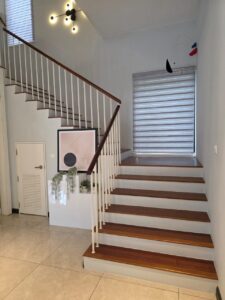
 In Vasthu Sastra, the ancient Indian science of architecture, nothing within a home is considered accidental.
Every direction, proportion, and movement is believed to influence the invisible currents of energy that shape our well-being.
Even something as ordinary as a staircase, often designed purely for function in modern homes, carries a deeper symbolic and energetic meaning.
One of the most widely discussed principles of Vasthu concerns the direction a staircase turns because the staircase is regarded as the heart of the house.
Many assume this rule is rigid, but like most ancient sciences, Vasthu is layered with interpretation, symbolism, and practicality.
The traditional preference for a clockwise ascent is rooted in the auspicious practice of clockwise movement around a sacred space.
This motion mirrors the sun’s journey across the sky and is believed to align human activity with cosmic rhythms.
A staircase that turns clockwise as one ascends is thought to support the natural flow of prana, or life force, within the home.
It is also a practical observation: for most people, particularly right-handed individuals, turning to the right feels more natural, stable, and safe.
Over time, ancient seers observed that spaces designed in harmony with natural movement felt effortless and reassuring, while those that went against it often felt unsettling.
From this understanding arose the belief that anti-clockwise staircases may symbolically resist natural flow, potentially leading to restlessness or unnecessary obstacles in life.
Vasthu regards an anti-clockwise staircase as inauspicious because it runs counter to the traditional cosmic movement, which is clockwise.
Such a configuration is believed to disrupt the smooth circulation of energy, creating resistance in energy flow and leading to stagnation or turbulence within the home.
This imbalance can affect the rhythm and balance qualities, which Vasthu associates with the dwellers’ hearts, symbolising harmony, steady circulation, and continuity.
An anti-clockwise staircase is therefore believed to disturb the rhythmic movement of energy within the house, potentially creating subtle strain on residents’ nervous and circulatory systems over time.
In spiritual traditions, anti-clockwise movement is also associated with withdrawal, dissolution, or funerary rites, reinforcing its inauspicious symbolism within a living space. According to Vasthu principles, such defects can be remedied through corrective measures, including Vasthu Yantra ceremonies intended to ease imbalance and restore energetic harmony.
Equally significant is the number of steps a staircase contains. Vasthu traditionally favours an odd number of steps, with the landing often concluding on counts such as 19, 21, or 23.
This principle is linked to an ancient method of counting steps based on laabam (gain) and nashtam (loss).
The rhythm is simple: the first step represents gain, the second loss, the third gain again, continuing in an alternating cycle.
An odd number of steps ensures that the final step, the moment one enters the home, ends on gain, symbolically inviting prosperity and positive outcomes.
There is also a deeper yogic symbolism at play. Ascending with the right foot and concluding the climb on the right foot, which an odd number of steps naturally ensures, is associated with the solar energy channel, linked to vitality, clarity, and success.
An even number of steps, by contrast, causes one to step into the home with the left foot, traditionally viewed as less auspicious in Vedic thought.
Yet it is essential to remember that Vasthu is not a rigid doctrine frozen in time.
It is ancient architectural wisdom meant to enhance harmony, comfort, and well-being, not to create fear or anxiety.
Over centuries, interpretations have evolved, and modern Vasthu practitioners often adapt these principles to suit contemporary lifestyles, space constraints, and safety considerations.
Beyond direction and step count, Vasthu also emphasises practical design.
Staircases should be uniform in height and width, well-lit, structurally sound, and free of cracks or damage.
These recommendations, while energetically symbolic, also make complete architectural sense.
A safe, balanced staircase promotes both physical stability and mental peace.
Ultimately, a staircase is more than a means of moving between floors.
In Vasthu, it represents ascent, growth, progress, and transition.
When designed with awareness, it becomes a quiet conduit of positive energy, guiding movement not just upward, but inward, towards balance, mindfulness, and harmony within the home.
In a world where modern architecture often races ahead of reflection, revisiting such ancient insights offers a gentle reminder: when we build with consciousness, even our steps can lead us toward prosperity and peace.
Award-winning writer Dr T. Selva is the author of the bestsellers Vasthu Sastra Guide and Secrets of Happy Living. To get a copy, WhatsApp 019-2728464. He can be reached at drtselvas@gmail.com. Facebook: Vasthu Sastra