


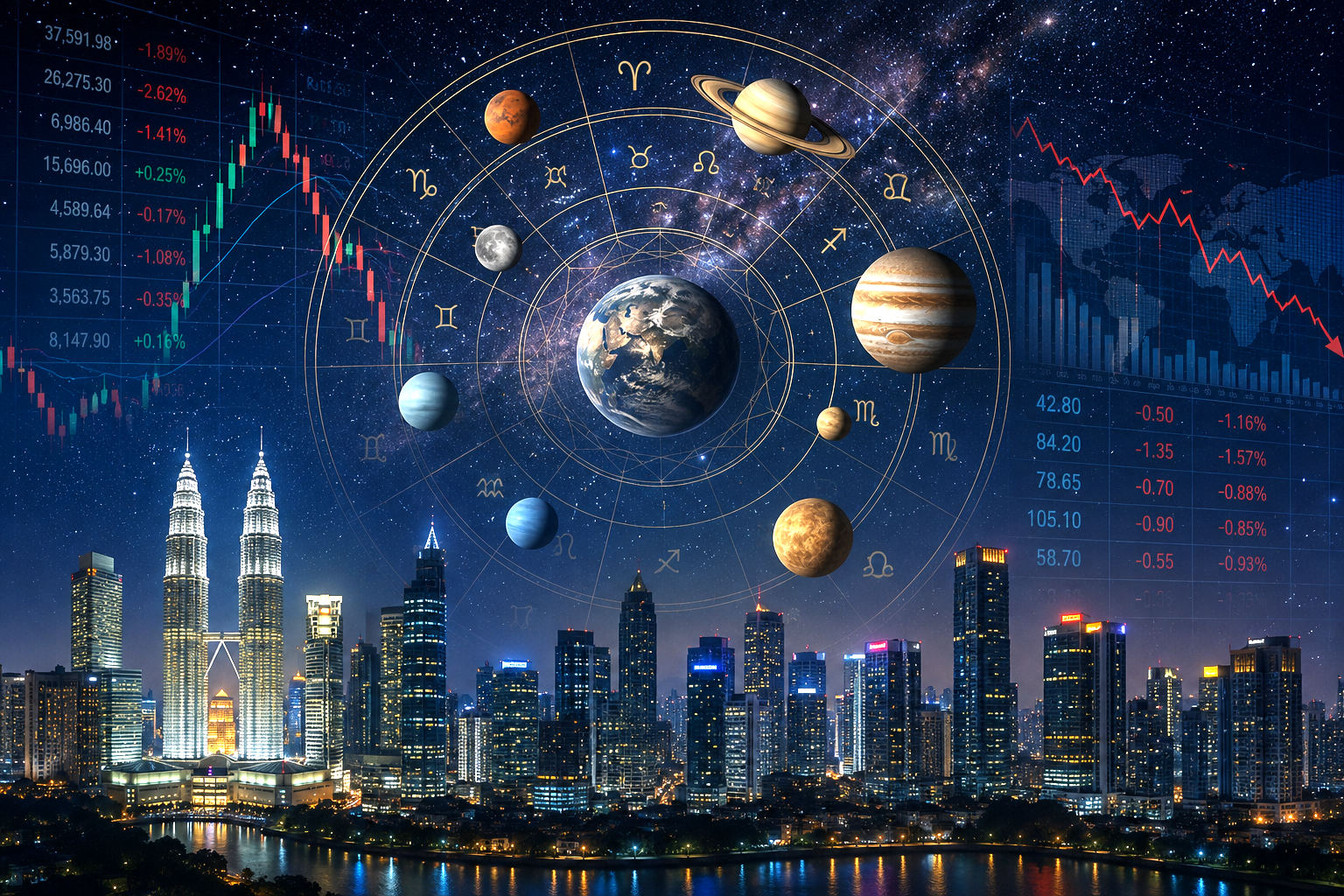

When the planets issue a warning
By Dr. T. Selva
Can the movements of planets offer a glimpse into the future of human affairs?
For centuries, astrologers have insisted they can.
Believers dismiss such claims as irrational belief, while practitioners point to historical
patterns that appear too striking to ignore.
A recent study by Indian financial astrologer and researcher Prof. Krish Murali Eswar from
Chennai has once again stirred this age-old debate.
After analysing nearly two decades of market data alongside planetary movements, he has
arrived at a sobering conclusion: the world may be approaching a particularly challenging
period beginning in August 2026 and lasting for approximately two years.
His warning is not based on prophecy in the traditional sense.
Instead, it is rooted in a statistical study of planetary cycles, stock market behaviour, and
recurring celestial patterns that he believes have coincided with some of the most significant
economic disruptions of modern times.
Prof. Murali shared his findings in his paper Financial Astrology: When the Market Dances
to Cosmic Music at the recent Malaysian Astrological Society International Astrology
Conference 2026 in Kuala Lumpur.
Among the patterns he highlights is Rahu’s (dragon head) movement through the lunar
mansion Dhanishta.
According to his research, the last time Rahu occupied this position was in late 2007.
Within months, the world witnessed the collapse of major financial institutions, culminating
in the Global Financial Crisis of 2008.
Prof. Murali notes that Rahu is expected to return to the lunar mansion on a fixed ephemeris
date of August 3, 2026, and remain there until around April 2027.
While he is careful not to predict another financial crash, he argues that history suggests this
is a period that deserves close observation and prudent preparation.
He also points to other planetary alignments that appeared during major market disruptions,
including the dot-com collapse, the aftermath of the September 11 attacks, the European debt
crisis, and the economic turbulence surrounding the Covid-19 pandemic.
To him, these celestial configurations are not causes of crises but indicators, cosmic signposts
that seem to coincide with periods of instability and transformation.
Whether one accepts astrology or not, there is an interesting lesson hidden within this
research.
True practitioners of financial astrology look at the sky not as a definitive crystal ball, but as
a quiet, extra opinion to overlay onto concrete market charts.
There is a sophisticated discipline to this approach, governed by strict operational rules:
Rule One: If the cosmic sky agrees with your foundational market charts, you may
choose to size up your positions or hold your ground longer than usual.
Rule Two: If the sky actively disagrees with your charts, it is a signal to cut your
exposure, step back, and let the chaos settle on your own terms.
Rule Three: Crucially, one must never make reckless financial moves blindly. Never
buy into a market solely because Rahu enters Dhanishta, and never short an
investment simply because a difficult astrological window opens. Cosmic signals are
tiebreakers to guide us, not standalone triggers for reckless action.
Throughout history, many ancient civilisations observed the heavens not merely for spiritual
reasons but as a guide to timing, planning and preparedness.
Modern society may have replaced astrology with economics, algorithms and artificial
intelligence, yet uncertainty remains a permanent feature of human existence.
Even in an era dominated by technology, the mathematical dates of transit are fixed realities
on the ephemeris, whether it is the looming August 3, 2026, timeline or the historical
alignments that mirrored the hardships of 2008 and 2020.
Yet, as financial experts rightfully warn, past cosmic patterns are not an absolute guarantee of
future financial returns.
Markets evolve, political regimes transform, and a signal that worked yesterday may express
itself differently tomorrow.
What makes Prof. Murali's warning noteworthy is not the planetary explanation itself, but the
practical advice that accompanies it.
He urges people to adopt a more cautious financial approach before August 2026.
Reduce unnecessary debt. Avoid reckless speculation. Build emergency savings. Strengthen
family support systems and hold on to your jobs. Focus on essentials rather than luxuries.
In essence, he advocates an austerity mindset.
Interestingly, this advice would be considered sensible even without any reference to
astrology, as leaders of most countries have cautioned their citizens about the impending
recession stemming from the crisis in the Middle East.
The global economy is already facing multiple challenges.
Geopolitical tensions continue to simmer.
Government debts have reached unprecedented levels in many countries.
Inflation remains a concern. Climate-related disasters are becoming more frequent and costly.
Technological disruption is transforming industries at a pace never seen before.
Against such a backdrop, preparing for uncertainty is simply prudent.
As the old adage goes, we must learn to plan our risks around established rules.
When the dancer and the music line up perfectly, that is the exact moment to pay closest
attention.
Ancient wisdom traditions often taught that difficult periods are not meant to be feared but
respected.
Just as nature experiences seasons of growth and decline, human societies also move through
cycles of prosperity and challenge.
If Prof. Murali’s analysis proves correct, the years ahead may test the resilience of
individuals, businesses and nations.
If it proves incorrect, those who adopted greater financial discipline and reduced unnecessary
risks will still benefit. Either way, there is little harm in exercising caution.
The future has never been fully predictable, whether through economics, science or astrology.
Yet one lesson remains timeless: those who prepare during calm weather are better equipped
to weather the storm when it arrives.
Perhaps that is the real value of such warnings. They remind us that prosperity should never
lead to complacency and that prudence is often the wisest investment of all.
As August 2026 approaches, the question is not whether the planets will determine our
destiny.
The question is whether we will use every available insight—ancient or modern—to prepare
wisely for whatever the future may bring.
Award-winning writer Dr. T. Selva is the author of the bestsellers Vasthu Sastra Guide
and Secrets of Happy Living. To get a copy, WhatsApp 019-2728464. He can be reached
at drtselvas@gmail.com. Website: www.vasthuguide.com

