
loading

Tag: dr.t.selva

  • Home
  • Tag: dr.t.selva

When seven horses inspire or disturb


Dr. T. Selva

Across cultures, symbols carry power, not merely as decoration, but as silent influencers of the human mind and environment.

One such widely popular image is that of the seven running horses, often displayed in homes and offices as a talisman of success and progress.

Yet, between the principles of Feng Shui and Vasthu Sastra, there exists an interesting divergence in interpretation.

In Feng Shui, the image of seven galloping horses is considered auspicious.

Horses symbolise speed, strength, endurance, and forward momentum.

When depicted in a group of seven, they are believed to amplify collective energy, driving success, enhancing reputation, and accelerating growth in one’s career or business.

The number seven itself is associated with unity, movement, and positive progression.

According to Feng Shui principles, such imagery is best placed in living rooms or offices, particularly in the south direction, which governs fame and recognition.

A key guideline is that the horses should appear to be running into the space, symbolically bringing in success rather than taking it away.

When chosen carefully, with harmonious and uplifting visuals, this image is said to energise ambition and inspire achievement.

However, when viewed through the lens of Vasthu Sastra, a more nuanced and cautionary perspective emerges.

Vasthu reminds us that images are not inert objects; they radiate subtle psychological and energetic vibrations that can influence the emotional climate of a space.

While horses undoubtedly symbolise power and dynamism, a depiction of seven charging or aggressively galloping horses may introduce an imbalance rather than harmony if not thoughtfully selected.

In Vasthu philosophy, such imagery can generate excessive active energy.

Instead of calm and steady progress, it may create a sense of restlessness, an unconscious push towards haste, impatience, and tension.

In a home environment, which ideally should nurture peace and emotional security, this can translate into anxiety, conflicts, or a persistent feeling of being “on edge.”

The posture and expression of the horses also matter greatly.

Images showing raised hooves, flared nostrils, or aggressive stances can symbolise attack or escape energy.

Such visuals may subconsciously disturb the mind, affect sleep patterns, and create subtle emotional unease, especially if placed in sensitive areas like bedrooms or near the main entrance.

Vasthu does not outright reject the symbolism of the seven horses.

In fact, it acknowledges their association with Surya, the Sun, and with movement and success.

However, it emphasises balance over blind symbolism.

The depiction should reflect controlled motion, grace, and harmony and not chaos or aggression.

If one chooses to display such artwork, it is advisable to select imagery where the horses appear calm yet purposeful, moving forward with elegance rather than frenzy.

Gentle and peaceful animals such as cows, deer, elephants, and swans are highly recommended.

The cow symbolises nurturing, abundance, and selfless giving, ideal for creating a soothing and spiritually uplifting atmosphere.

Deer represent gentleness and sensitivity, bringing calmness and grace into a space. Elephants, especially with trunks down and not raised, are powerful symbols of wisdom, protection, and prosperity, while swans signify purity, peace, and positive transformation.

Peacocks represent longevity, beauty, and positive energy.

Placement in the living and work space can be more supportive, aligning with growth and clarity while avoiding overstimulation of the living space.

In essence, the difference lies not in the symbol, but in its expression and context.

Feng Shui celebrates the dynamic energy of the horses as a catalyst for success, while Vasthu gently cautions against excess, reminding us that true prosperity must coexist with peace.

After all, progress is most meaningful when it is steady, balanced, and harmonious and not when it feels like an endless race.

Ultimately, the choice of what we display in our homes and workspaces should be made with mindfulness and awareness.

Every image or photograph we place on our walls is not merely decorative, it carries a subtle energy that quietly influences our thoughts, emotions, and behaviour.

When we become conscious of these unseen effects, we can create spaces that not only reflect success and progress but also nurture peace, balance, and inner harmony.

Award-winning writer Dr. T. Selva is the author of the bestsellers Vasthu Sastra Guide and Secrets of Happy Living. To get a copy, WhatsApp 019-2728464. He can be reached at drtselvas@gmail.com. Website: www.vasthuguide.com
Discovering inner peace through Silent Day


By Dr. T. Selva

Each year, as I touch down upon Bali—the Island of the Gods—I am struck by a familiar realisation: some journeys are measured not in miles, but in the depth of one’s own silence. This year marks my seventh consecutive pilgrimage to witness Nyepi, the Silent Day festival. In a world that rarely stops talking, returning to this sacred stillness has become a vital ritual for my own spiritual architecture.

And yet, despite having witnessed it multiple times, the experience continues to unfold in new and transformative ways.

Nyepi is not just a cultural observance; it is a living philosophy. Rooted in the Balinese Hindu tradition, it is a day dedicated entirely to silence, reflection, and self-restraint.

But what makes Bali truly extraordinary is the collective discipline of its people.

On March 19, for 24 hours, I joined the entire island in coming to a standstill.

Airports close, seaports cease operations, roads are emptied, and even the hum of daily life disappears into an almost sacred stillness.

Over 4.4 million people participate in this silent observance, each one honouring the same commitment to turn inward.

My journey into Nyepi began, as it traditionally does, with the deeply symbolic sea purification ritual known as the Melasti ceremony.

Along the shores of Denpasar, I witnessed lines of devotees dressed in pristine white, carrying sacred temple objects toward the ocean.

The sea, vast and timeless, becomes a spiritual cleanser, absorbing impurities, both seen and unseen.

As waves gently touched the offerings, there was a palpable sense of surrender, as if burdens accumulated over the year were being released into the infinite.

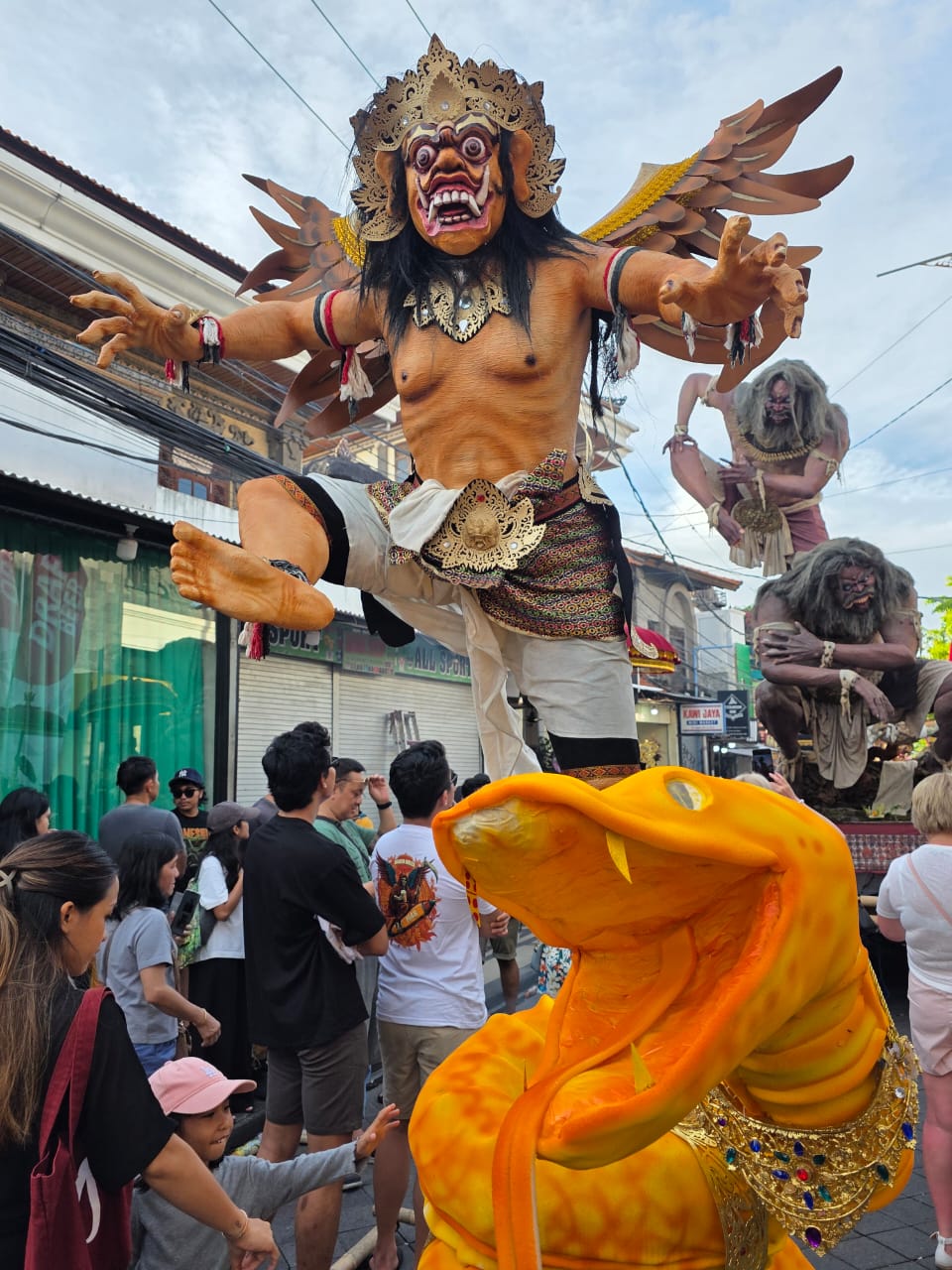
This was followed by one of the most visually striking events, the Ogoh-Ogoh parade. Towering effigies, often grotesque and fearsome in appearance, were paraded through the streets with rhythmic music and vibrant energy.

These figures symbolise negative forces, inner demons, and destructive energies that reside within and around us.

The Ogoh-Ogoh were ceremoniously burned, representing the cleansing of darkness and the triumph of purity on the eve of Nyepi.

What fascinates me most is the reflective wisdom embedded in this sequence.

Before silence, there is acknowledgment. Before stillness, there is release.

It is a reminder that we cannot enter peace without first confronting the chaos within.

Then came Nyepi itself.

From dawn, a blanket of silence descends upon Bali. There were no lights, no travel, no work, and no entertainment. Even conversations were kept to a minimum.

As I remained indoors, away from screens, artificial light, and the distractions that usually dominate modern living, I found myself entering a space that is increasingly rare in today’s world, true solitude.

It is in this silence that one begins to hear. Not external sounds, but the inner voice that is often drowned by the noise of daily life.

The stillness is so intense that even nature seems to respond.

The skies appear clearer, the air feels lighter, and at night, the stars shine with a brilliance rarely seen elsewhere.

There is a sense that the island itself is breathing, resting, and rejuvenating.

What makes this experience even more powerful is the shared understanding among the Balinese people.

There is no enforcement in the conventional sense, only a deep cultural respect and spiritual commitment.

Even visitors were gently guided to honour the day’s sanctity. It is perhaps the only place in the world where silence is observed so collectively and so completely.

As someone deeply immersed in the principles of Vasthu Sastra, I could not help but reflect on the alignment between Nyepi and the concept of energy balance.

In Vasthu, we speak of harmonising the five elements and creating spaces that nurture peace and clarity. Nyepi, in essence, is Vasthu at a societal level, an entire island resetting its energy, clearing accumulated negativity, and restoring equilibrium.

In our modern world, we are constantly surrounded by movement – physical, mental, and emotional.

We chase deadlines, engage in endless conversations, and expose ourselves to a relentless stream of information.

Over time, this leads to imbalance, stress, and inner turbulence.

Bali, through Nyepi, offers a powerful antidote.

It teaches us that silence is not emptiness—it is fullness.

It is in silence that clarity emerges, that emotions settle, and that the mind regains its natural rhythm.

When we disconnect from the external, we reconnect with the essential.

This experience also highlights a deeper truth: peace is not something to be found outside; it is something to be cultivated within.

The Balinese people have understood this for generations. By dedicating just one day to complete stillness, they preserve a sense of harmony that many societies struggle to achieve despite technological advancement and material progress.

As I sat in quiet reflection at my hotel in Baruna, I became acutely aware of how rare such moments are in my everyday life.

The absence of noise was not uncomfortable; it was liberating.

Without the distractions of devices, conversations, and obligations, I found myself more present, more aware, and more connected to my inner self.

It is this awareness that we must strive to bring into our daily lives.

While it may not be practical for everyone to observe a full day of silence as in Bali, we can certainly adopt elements of this practice.

Setting aside time for quiet reflection daily or weekly, reducing digital distractions, and consciously creating moments of stillness can strongly impact our well-being.

In a world increasingly defined by conflict, tension, and aggression, Bali stands as a gentle reminder that another way of living is possible.

A way rooted in mindfulness, balance, and respect for both the inner and outer environment.

Nyepi is more than a festival—it is a message.

A message that true progress is not measured by how fast we move, but by how deeply we understand ourselves.

A message that silence is not a void to be feared, but a space to be embraced.

As I conclude my seventh Nyepi experience, I carry with me not just memories, but a renewed commitment to live more consciously, to speak more mindfully, and to create spaces of peace both within and around me.

For in the heart of silence, we do not lose ourselves, but we find ourselves.

Award-winning writer Dr. T. Selva is the author of the bestsellers Vasthu Sastra Guide and Secrets of Happy Living. To get a copy, WhatsApp 019-2728464. He can be reached at drtselvas@gmail.com.                       Website: www.vasthuguide.com

Centre of Astrological Study asks astrologers to shift focus on Vastu Shastra

Jamshedpur: Centre of Astrological Study & Research for Public Welfare, under the leadership of Vice Chancellor S. Kumar Shastri, announced a notable shift in focus among Jyotish Acharyas towards Vastu Shastra. In a press conference held earlier today, Shastri revealed that the institution has witnessed a rapid rise in interest in Vastu Shastra, with more students and practitioners gravitating towards the discipline due to its integration of astrology and science.

Shastri emphasized that the curriculum at the Jyotish Shikshan Sansthan is based on scientifically-backed formulas, setting it apart from any other educational institutions in India. The unique approach of combining astrology, palmistry, and Vastu Shastra in the teaching process has made this institution a trailblazer in astrological education. He added that the Vastu Shastra program, in particular, holds a special status nationwide, as it is designed with a rare blend of ancient wisdom and modern scientific methodology.

The announcement was made during a special Teacher’s Day event held at Hotel Boulevard, Bistupur, organized by the Jyotish Shikshan Sansthan of Jharkhand. At the event, newly elected members of the governing body were formally anointed, including Dr. Tapan Rai as Sabha President, Dr. Rajesh Bharti as Secretary, and Dr. Narendra Kumar as Jharkhand State President. The council committee includes Suprabha Bhattacharya, Shubhlaxmi Banerjee, Madhuri Kumari, Munmun Rai, Usha Sonkar, and Padma Kumari Jha, with astrologer Pragyanand Kumar taking charge of the training center.

Shastri outlined how this year’s celebration featured a detailed analysis of astrology, palmistry, and Vastu Shastra. Students shared their experiences, and practical training sessions were arranged. The Vice Chancellor noted that the inclusion of astrological advice in daily life, when followed correctly, can lead to personal and professional growth.

Additionally, Shastri announced the reformation of the institution’s committee, with key figures such as J.B. Murali Krishna as Director, Dr. Tapan Rai as Chairman, Abhijit Chakraborty as President, and Vijay Chakraborty as Vice President. Dr. Rajesh Bharti was named General Secretary, while Dr. Suresh Jha also joined the committee.

With a curriculum deeply rooted in both astrology and science, the institution continues to establish itself as a unique center of learning, shaping the future of astrological education in India.