



By Dr. T. Selva
Before the first wall rises, before concrete is poured and long before a family moves into a
new home, there is an ancient tradition that reminds us of something easily forgotten: the land
comes first.
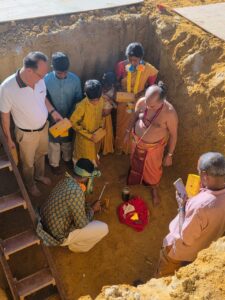
I was reminded of this principle when I recently witnessed a Bhoomi Puja, or groundbreaking
ceremony, for the construction of a bungalow.
Chief Priest Someshvarn Sivachariar, conducted it before the owners, family, relatives,
friends and builder.
The ceremony was held on an auspicious day and at 4.30 am, in accordance with Hindu
tradition.
This was not merely the symbolic turning of soil associated with a groundbreaking ceremony.
Every prayer, offering and gesture carried meaning.
In Vasthu Sastra, land is not regarded merely as a commodity upon which a building is
constructed. It is honoured as Bhoomi, or Mother Earth, the foundation that supports
everything built upon it.
Before the earth is disturbed by construction, the ground-breaking ceremony is performed to
seek the blessings and, symbolically, the permission of Mother Earth.
To build, we must cut into the soil, remove earth, lay foundations and place an enormous
structure upon the land.
The ceremony acknowledges this intervention and seeks harmony among the land, the
building, and its occupants. The tradition carries a beautiful message: before we take from the
earth, we first bow to it.
A significant part of the ceremony took place in the northeast sector. A hole six feet deep had
been prepared there for the offerings.
In Vasthu Sastra, the northeast is regarded as the most sacred and sensitive sector of a
property.
It is associated with purity, spiritual consciousness, divine grace and positive energies.
This is why Vasthu recommends keeping it open, clean, light and free from unnecessary
heaviness.
Invoking divine blessings from this quadrant symbolises beginning the home from a point of
purity and higher consciousness.
One memorable moment was the ceremonial placement of nine new bricks.
Nine is significant in Hindu philosophy and Vasthu. It is associated with completeness and
the Navagrahas, the nine planetary influences recognised in Vedic tradition.
The concept also resonates with the Vasthu Purusha Mandala, the cosmic man, through which
land and buildings are understood as an organised field of directions, forces and energies.
Once blessed and placed, the nine bricks are no longer viewed merely as construction
materials.
They become part of the spiritual foundation, representing stability, protection, harmony and
an auspicious beginning.
Thousands of bricks may eventually be used to construct the bungalow, but these first nine
are different. They are placed not by workers during ordinary construction, but with prayers,
intention and blessings.
The physical house begins with a spiritual foundation.
Other sacred objects were placed in the opening, including a gold Trisul, nine gemstones,
conch shell, gold pyramids, coins and consecrated items prescribed for the ceremony.
The Trisul, or trident, is associated with divine power and protection. Gemstones have long
been connected in Indian traditions with planetary and cosmic influences.
The conch shell is used to dispel negative energies and invite peace, prosperity, and positive
vibrations into the land and the new home.
Metals, coins and sacred geometric objects similarly symbolise prosperity, stability,
protection and abundance.
After the ceremony, these offerings disappear beneath the earth. The owners may never see
them again, yet that is what makes the act meaningful.
They are not placed there for decoration or display. They become part of the unseen
foundation, reminding us that some of the most important forces supporting a home are
invisible.
Another touching aspect was the participation of everyone present. This was not an event
solely between the priest and owner.
Family members took part, while relatives and close friends offered prayers and good wishes.
The builder also stepped forward and respectfully placed a brick and flowers into the sacred
hole.
His participation was meaningful. A builder normally enters a property carrying drawings,
measurements, machinery and construction materials. On this occasion, however, he
approached the earth with a brick and flowers.
That simple gesture carried a powerful message. The person entrusted with physically
constructing the house was also participating in the spiritual blessing of its beginning.
Priest, owners, builder, family and well-wishers became connected to the first chapter of the
bungalow.
Modern construction naturally focuses on architectural drawings, engineering calculations,
approvals, budgets and completion dates. All are essential.
Bhoomi Puja, however, introduces another dimension: consciousness, humility and gratitude.
It reminds us that a house should not begin only with machinery breaking the ground.
It should begin with prayer, positive intention and respect for the land that will support it.
Not everyone has the opportunity to perform such an elaborate ceremony. However, those
fortunate enough to acquire land and build a home from the ground up should consider
beginning the project with an appropriate groundbreaking observance.
From a Vasthu perspective, this is an important beginning for a new property.
A bungalow may eventually be admired for its magnificent entrance, beautiful rooms, grand
staircase, expensive finishes and landscaping, but its true story begins much earlier.
It begins on an empty piece of earth, surrounded by loved ones, with sacred prayers filling the
air, nine bricks waiting to become part of the foundation and flowers falling gently into the
soil.
Everyone present carries one common hope: may the home that rises from this earth bring
peace, protection, prosperity, health and happiness to all who live within it.
Award-winning writer Dr. T. Selva is the author of the bestsellers Vasthu Sastra Guide
and Secrets of Happy Living. He can be reached at drtselvas@gmail.com. Website:
www.vasthuguide.com