



By Dr. T. Selva
I was invited to visit the Rebel Heart: Love Letters and Other Declarations exhibition at the
State Library Victoria in Melbourne last week and I found myself deeply moved.
As someone who has spent decades studying the ancient science of Vasthu Sastra, I expected
to admire a historical collection of handwritten love letters, intimate diaries and rare
manuscripts.
Instead, I left reflecting on something far more reflective: the timeless power of love and the
environment in which it flourishes.
The exhibition beautifully demonstrates that love has never been confined by time, culture or
social expectations.
Across centuries, people have risked rejection, persecution and heartbreak simply to express
what their hearts could no longer keep hidden.
Their words continue to speak to us today with remarkable honesty and tenderness.
One of the first stories that caught my attention was that of the Roman poet Publius Ovidius
Naso, better known simply as Ovid.
Nearly two thousand years ago, his celebrated work The Art of Love offered practical advice
on courtship and romance.
His writings became immensely popular but also deeply controversial, eventually
contributing to his exile from Rome.
His story reminds us that love has often challenged society’s rules, proving that the human
heart cannot easily be controlled.
Equally fascinating was the story of Robert Burton, whose monumental work The Anatomy of
Melancholy explored the emotional complexities of love.
First published in 1621 and expanded over several editions, Burton described love as both an
inspiring force and a source of anguish, obsession and despair.
Reading his observations, I realised that although centuries separate us, the emotional journey
of love has remained remarkably unchanged.
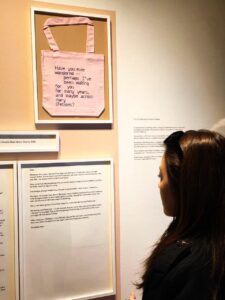
Yet, among all the remarkable exhibits, one simple display touched me the most.
Hanging quietly on the gallery wall was an ordinary pink tote bag carrying an extraordinary
message:
“Have you ever wondered – perhaps I’ve been waiting for you for many years, and maybe
across many lifetimes?”
Those words stopped me in my tracks.
It was remarkable how an everyday shopping bag had been transformed into an insightful
declaration of love.
Without expensive materials or elaborate design, it conveyed hope, longing, patience and
steady faith.
It reminded me that love often reveals itself not through grand gestures but through the
simplest expressions that speak directly to the soul.
Nearby were handwritten letters hidden for years before finally being discovered, revealing
the silent suffering, enduring hope and unwavering devotion of lovers separated by distance,
circumstance and time.
Reading those intimate words, I realised that while technology has transformed how we
communicate, it has not changed what we long for.
Every generation continues to seek acceptance, companionship, understanding and
unconditional love.
As I walked through the exhibition, one thought became increasingly clear.
Love may begin in the heart, but it flourishes—or slowly fades—within the environment that
surrounds it.
This timeless truth has been taught by Vasthu Sastra for thousands of years.
While modern society often views love purely as an emotional or psychological experience,
Vasthu reminds us that our homes continuously influence our thoughts, emotions and
relationships.
Every room, every direction and every flow of energy subtly affect the way family members
communicate, resolve conflicts and express affection.
A couple may genuinely love each other, but if they live in a home filled with energetic
imbalances —such as an afflicted south-west, a disturbed north-east, bedrooms placed in
unsuitable quadrants, or constant clutter and disharmony—the relationship may gradually
become burdened by misunderstandings, emotional distance, and unnecessary tension.
Conversely, a well-balanced home becomes a silent partner in the relationship.
It encourages calm conversations instead of arguments, understanding instead of resentment
and mutual respect instead of conflict.
The home itself quietly supports the love shared by those who live within it.
This does not mean that Vasthu creates love.
Rather, it creates an environment in which love can breathe, mature and endure.
Just as a beautiful flower requires fertile soil, adequate sunlight and sufficient water to
blossom, human relationships also need the right surroundings to reach their fullest potential.
Even the strongest love can struggle when constantly exposed to stress and imbalance, while
ordinary relationships often grow stronger in peaceful and harmonious surroundings.
Leaving the exhibition, which ends in January 2027, I carried with me far more than
admiration for its beautiful collection.
I accepted a renewed appreciation that throughout history, people have always searched for
lasting love.
They have written poems, hidden letters, composed songs and preserved treasured keepsakes
in the hope that love would survive the passage of time.
The ancient masters of Vasthu Sastra understood another equally important truth.
Love deserves not only to be expressed. It deserves to be protected.
Sometimes, the greatest love letter we can offer our spouse, our children and our family is not
written with ink on paper.
It is the thoughtful creation of a harmonious home where love is given every opportunity to
flourish, for this lifetime, and perhaps, as the pink tote bag so beautifully suggested, for many
lifetimes to come.
Award-winning writer Dr. T. Selva is the author of the bestsellers Vasthu Sastra Guide
and Secrets of Happy Living. To obtain a copy, WhatsApp 019-2728464. He can be
reached at drtselvas@gmail.com. Website: www.vasthuguide.com