


By Dr. T. Selva
Framed by the dazzling glow of Singapore’s skyscrapers, I found myself drawn into a
spectacle that was both rare and deeply sacred.
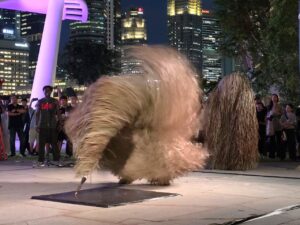
Before me, a towering figure made entirely of straw leaped, spun, and swirled with
astonishing energy at the Singapore Esplanade Courtyard.
For over 30 minutes, it moved tirelessly in a trance, accompanied by rhythmic drumming,
spirited singing, and the sharp metallic chime of bells.
At moments, it seemed almost unreal, as though the laws of the physical world had briefly
stepped aside.
This was the Kumpo, the dance of the spirit protector, performed at the opening of the
Tapestry of Sacred Music 2026 in Singapore on Thursday.
Using a stick fixed to the top of its head as a pivot, the figure executed rapid, dizzying spins,
at times moving close to fire as if to embrace it, yet never burning.
It is not regarded as a person in costume, but as a manifestation of the spirit world itself.
This is why the performer’s identity remains completely concealed, covered in layered straw,
with only a pole rising from the head, symbolising a link between heaven and earth.
The Kumpo was not merely a performance. It is believed to be an ancestral spirit, one that
bridges the world of the living and the unseen realm.
In its presence, I sensed that protection is not just physical, but deeply spiritual.
What struck me most was not merely the visual intensity of the dance but the powerful
collective energy it stirred and shared among those present.
It felt like a truly unique cleansing process, one that drove away negative forces.
The Kumpo moved among the people, blessing, engaging, even playfully confronting, yet
always commanding reverence.
It reminded me that in many ancient traditions, spirituality is not silent or distant, it is alive,
expressive, and communal.
The origins of this sacred dance lie among the Jola people of West Africa, particularly in
southern Senegal and The Gambia.
Their lives are deeply rooted in nature through farming, rice cultivation, and traditional
medicine.
At the heart of their belief system is Ata Emit, the supreme being who governs the skies and
seasons.
Their spiritual practices include shrines, rituals, and protective charms, each serving as a
shield against unseen forces and a channel for divine blessings.
As I watched the Kumpo whirl in rhythmic precision, I could not help but reflect on the
principles of Vasthu Sastra, the ancient Indian science of space, energy, and harmony.
Vasthu teaches us that every space carries a vibration.
When aligned correctly, it invites health, prosperity, and peace.
When disturbed, it can create restlessness, obstacles, and imbalance.
The remedies prescribed in Vasthu, whether through spatial corrections, sacred symbols, or
rituals, are ultimately meant to restore protection and positive flow within a dwelling.
In many ways, the Kumpo serves a similar purpose, but at a community level.
Dressed in a full-body costume of raffia palm leaves, bound with bark ropes and crowned
with a wooden staff, the Kumpo is no longer seen as human once adorned.
It becomes a vessel, a guardian spirit connected to divine and ancestral energies. As it dances,
it is believed to cleanse the environment, drive away negativity, and reinforce unity among
the people.
This is not unlike the Vasthu concept of activating and protecting a space.
Just as we place sacred elements in a home to stabilise energy, the Jola community invokes
the Kumpo to energetically fortify their surroundings.
The spinning motion itself—continuous, circular, and powerful—felt like a living yantra,
generating and redistributing energy across the space.
The drumming, clapping, and chanting further amplify this vibrational field, much like
mantras in our own spiritual traditions.
At the end of the dance, the Kumpo communicates through an interpreter, delivering
messages that range from practical guidance to moral reminders.
It is, in essence, a spiritual audit of the community, ensuring that harmony, discipline, and
collective responsibility are upheld.
In today’s fast-paced, individualistic world, such practices may seem distant or even mystical.
Yet their underlying principles are universal. Every culture, in its own way, acknowledges the
need for protection, both seen and unseen.
Whether through the structured alignment of Vasthu or the dynamic expression of the Kumpo
dance, the intention remains the same: to create spaces where life can flourish in balance.
Witnessing this ritual in a modern city like Singapore was particularly meaningful. It was a
reminder that no matter how advanced our surroundings become, our inner need for
connection, protection, and spiritual grounding remains unchanged.
The Kumpo does not merely dance; it protects, purifies, and unites.
And perhaps, it gently reminds us of something we often overlook: that the spaces we inhabit,
like the lives we lead, must be consciously energised, protected, and aligned.
For in the end, whether through a sacred dance in West Africa or the principles of Vasthu in
our homes, the goal is the same—to live in harmony with forces greater than ourselves.
Award-winning writer Dr. T. Selva is the author of the bestsellers Vasthu Sastra Guide
and Secrets of Happy Living. To get a copy, WhatsApp 019-2728464. He can be reached
at drtselvas@gmail.com. Website: www.vasthuguide.com