


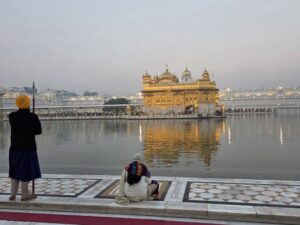
 It was just before dawn in Amritsar, India, when I stepped barefoot into the world’s sacred precinct that never sleeps, the Sri Harmandir Sahib, the Golden Temple.
Last week, despite the cold winter air, my heart felt unexpectedly warm.
As I bowed my turbaned head and entered through the arched gateway, I was reminded that this was not merely a visit to a holy site, but my pilgrimage, one that gently strips away ego, labels and restlessness, leaving only humility and stillness behind.
From a Vasthu Sastra perspective, holy spaces are never accidental.
Their placement, orientation, openness and flow are carefully aligned to harmonise cosmic energies with human consciousness. The Golden Temple is a living embodiment of this ancient wisdom.
Built at ground level, unlike most places of worship that rise above, it symbolises humility, equality and openness.
One does not climb to reach the Divine here; one descends inward.
I have made more than a dozen pilgrimages to the Golden Temple over the years, yet each visit feels like my first, for the connection it offers is never the same, always renewed.
The first sight of the temple shimmering in the Amrit Sarovar, a holy man-made lake excavated by the fourth Sikh Guru, Ram Das, in the late 16th century and known for its spiritual significance and healing properties, is unforgettable.
Water, according to Vasthu and spiritual science, is a powerful conductor of energy and memory.
Sitting on the banks of the lake, I felt an immediate quietening of the mind.
The reflection of the gleaming sanctum in the still waters reminded me that spiritual clarity arises only when the inner waters are calm.
Many devotees rush straight to darshan, but I chose to sit by the water first, allowing the space to prepare me.
As I gently walked the parikrama, a Vedic tradition of circumambulating water, barefoot on the cold marble, each step became a form of meditation.
In Vasthu, circumambulation is not merely ritualistic; it aligns the human energy field with the rhythmic flow of space.
Walking clockwise around a sacred centre balances the nervous system and grounds wandering thoughts.
I noticed how even the most hurried souls unconsciously slowed down here.
Inside the temple, the live, soulful recitation of holy hymns, Gurbani, filled the air.
Sound, like space, is a powerful carrier of energy.
I sat in stillness and spent hours in the spiritually energised enclosure, even without understanding every word; the kirtan’s vibration penetrated deeply, bringing tears to flow naturally.
In Vasthu terms, blessed sound activates dormant energies within a space and its occupants.
It is no coincidence that the Golden Temple is never silent, day or night, prayer flows continuously, keeping the spiritual energy alive and vibrant.
After receiving blessings called darshan through the auspicious gaze of the holy book, I accepted the karah prasad (a sweet pudding in Sikhism) with cupped hands.
This simple act carries symbolic meaning. It teaches receptivity, a quality often missing in modern life and modern homes.
In Vasthu, a house that is too closed, too rigid, or too defensive blocks abundance.
Similarly, a heart unwilling to receive grace remains unfulfilled.
No pilgrimage to the Golden Temple is complete without the langar, the world’s biggest community kitchen that serves free food to 50,000 to 100,000 visitors daily.
Sitting cross-legged on the floor alongside strangers from every walk of life, I was struck by the thoughtful spatial equality this arrangement creates.
There are no elevated seats, no special enclosures, no hierarchy.
In Vasthu, a balanced space is one in which the ego dissolves, and harmony prevails.
The hall is perhaps one of the most spiritually powerful dining spaces in the world, not because of its architecture, but because of the intention infused into it.
What makes the Golden Temple truly unparalleled is not just its sanctity, but its lived spirituality.
The continuous food served there is not charity; it is equality in action.
In a world divided by status, wealth, and belief, the Golden Temple quietly teaches humanity’s highest lesson, that service to people is service to the Divine, and compassion never sleeps.
I also spent time observing volunteers cleaning floors, cutting vegetables, serving food, and washing utensils, all with quiet dedication.
From a spiritual and Vasthu viewpoint, spaces retain the imprint of actions performed within them.
Continuous selfless service keeps the Golden Temple energetically pure.
It made me reflect on our homes: how often do we consciously cleanse them not just physically, but emotionally and energetically through prayer, gratitude, and service?
Despite the temperature dropping 3 degrees, I made it a point to visit during the early morning hours, known as Amrit Vela, the time to connect with the Divine.
The tranquillity at that hour is indescribable.
In Vasthu, the pre-dawn period is considered the most sattvic, ideal for prayer, contemplation, and setting intentions.
The Golden Temple at that hour felt less like a physical structure and more like a breathing, living presence.
Before leaving, I returned once more to the edge of the lake and sat in silence.
Pilgrimages, I believe, are not meant to impress us with grandeur, but to quietly transform us. The Golden Temple teaches insightful Vasthu lessons without ever naming them: openness, balance, humility, continuous purification, and alignment with natural elements.
As I walked out after spending five days here, covering my head once again, I realised that the true journey begins after one leaves the sanctified space.
The challenge is to recreate the same harmony in our homes and hearts, to build spaces that nurture peace, design lives that allow flow, and live with humility regardless of status or success.
The Golden Temple does not ask who you are, where you come from, or what you believe.
It only asks that you enter with respect and reverence and leave lighter than when you arrived.
In a world increasingly cluttered with noise and division, this revered space stands as a timeless reminder that when space is aligned with spirit, the soul naturally finds its way home.
To me, the sleepless Golden Temple stands as the world’s foremost pilgrimage site. It opens its doors and its heart to everyone, without distinction, welcoming and feeding all, twenty-four hours a day.
Award-winning writer Dr T. Selva is the author of the bestsellers Vasthu Sastra Guide and Secrets of Happy Living. To get a copy, WhatsApp 019-2728464. He can be reached at drtselvas@gmail.com. Facebook: Vasthu Sastra